Disclosure: this article contains affiliate links. If you buy or book through them we may earn a commission, at no extra cost to you.
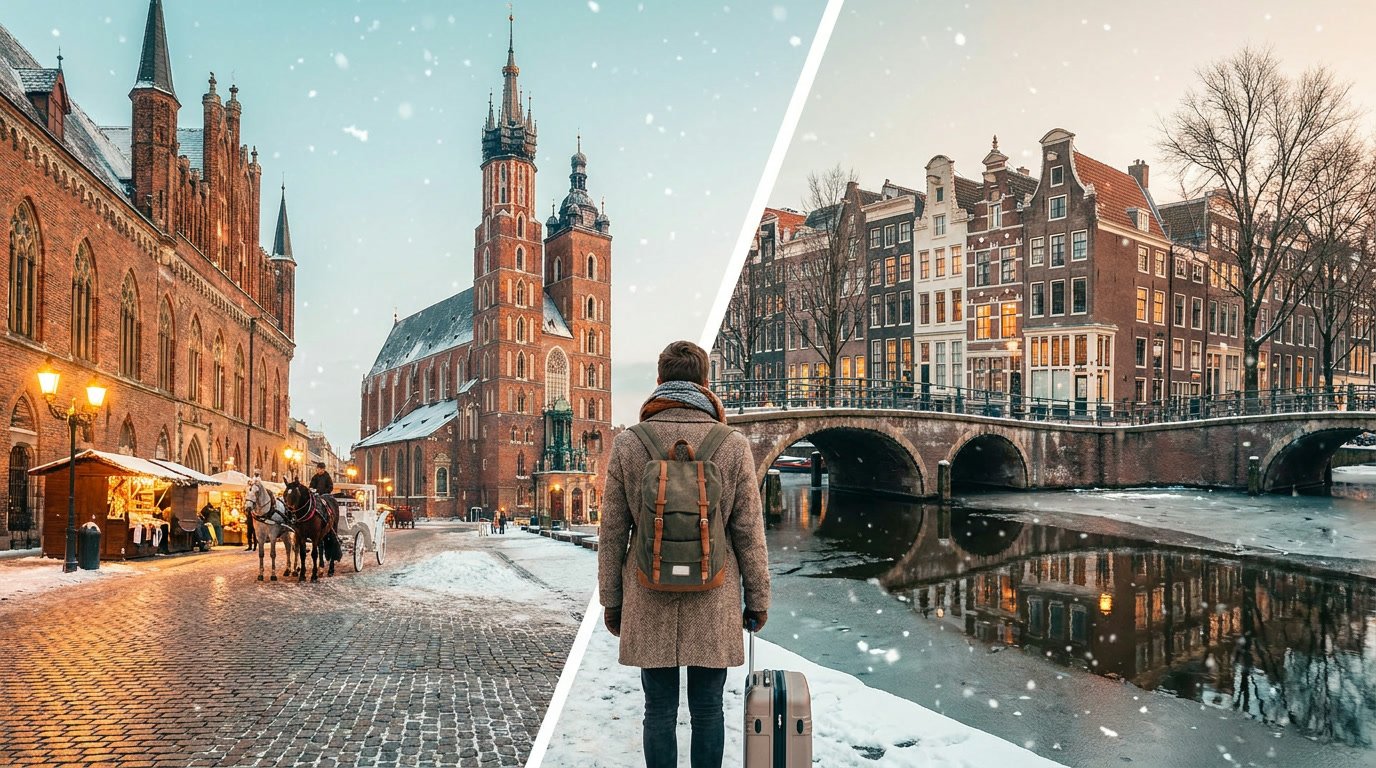
Both cities hand you a proper European winter: cobblestone squares, glühwein stalls, a Christmas market dressed up like a postcard. They suit very different first-timers, though. Kraków gives you the snowy, deep-cold, big-medieval-square Christmas most people picture — and you can sometimes fly into it nonstop. Ghent is milder, wetter, smaller, and gorgeously canal-lit, but you’ll land in Brussels and train in. Here’s how the two actually stack up for a December or January trip, with the entry rules, weather, and logistics you need sorted before you book.
The quick verdict
- Pick Kraków if you want the classic snowy market scene, the simplest “land in the city you came for” arrival from Chicago or Newark, and a lower everyday spend (Poland uses the złoty, not the euro).
- Pick Ghent if you’d rather skip subzero nights, love canal-and-gabled-house scenery, and don’t mind a one-hour train from Brussels plus a damp, rainy climate.
One difference actually matters for 2026: the US State Department rates Poland at Level 1 (“exercise normal precautions”), while Belgium was raised to Level 2 (“exercise increased caution”) on July 23, 2026, citing crime, terrorism, and civil unrest. That’s no reason to cancel Ghent — plenty of Level 2 countries are routine tourist stops — but first-timers should read the current notice at travel.state.gov before departure, because advisories shift.
Entry rules for US travelers (read this before you book)
Both cities sit in the Schengen Area, so the same rules cover either trip:
- Visa-free short stays: US citizens can stay up to 90 days within any rolling 180-day period, counted across all Schengen countries combined.
- EES (Entry/Exit System): The EU’s biometric border registration — fingerprints and a photo for non-EU travelers — began rolling out October 12, 2025 and reportedly finished Schengen-wide by April 10, 2026. There’s nothing to apply for ahead of time, but expect biometric kiosks at your first Schengen entry point. Pad your schedule for passport control.
- ETIAS: The EU’s pre-travel electronic authorization (a small fee, figures reported around €20) is not required yet as of this writing. Official messaging pointed to late 2026, but several 2026 outlets say it may slip into 2027, with no confirmed start date. Check the official ETIAS page before you book either trip — don’t assume, because this is the piece that keeps moving.
The EU doesn’t legally require travel insurance for a short US tourist stay, but it’s strongly recommended for both cities. Medical costs abroad and winter-weather flight chaos are exactly what a policy covers.
Getting there: Kraków wins on simplicity
Here’s where first-timers feel the biggest practical gap.
Kraków (KRK)
You can sometimes fly nonstop into the destination city itself. LOT Polish Airlines runs nonstop from Chicago O’Hare (about 5x weekly) and Newark (EWR), roughly 8h40m–9h20m in the air. The old JFK–Kraków nonstop appears to be gone, and most other US cities need one connection (via Scandinavian, Lufthansa, and the like). Land, grab a taxi or train into town, done.
Ghent (no airport)
Ghent has no airport of its own. You fly into Brussels Airport (BRU, Zaventem), about 56 km away, then catch a direct train that runs roughly 45–65 minutes (an “airport supplement” is usually bundled into the fare). Brussels has nonstop US service via Brussels Airlines (JFK and Washington Dulles) and United (Newark, Chicago O’Hare, Dulles). The connection is easy — Belgian trains are frequent and reliable — but it’s still a transfer with luggage after a transatlantic flight.
Winter fares swing hard depending on your dates, so compare both routings side by side before you commit. Run a flexible-date flight search for KRK and BRU from your home airport; nudging a departure by a day or two around the holidays can move the price a lot.
Currency and daily spend
Kraków: Poland uses the Polish złoty (PLN) and has not adopted the euro. As of November 2026, 1 PLN was roughly $0.25–$0.27 (reconfirm with a live source like XE or Google Finance before you go). In practice, Kraków is one of the better-value city breaks in Europe — market food, drinks, and sit-down meals stretch a US dollar further.
Ghent: Belgium uses the euro, around $1.11–$1.13 per €1 in early-to-mid November 2026. Expect Western-European pricing, closer to Amsterdam or Paris than to Poland.
If either city charges a local tourist or accommodation tax, it’s usually small and tacked onto your hotel bill — worth confirming when you book your room.
Winter weather: snow vs. drizzle
These two cities feel like different seasons entirely.
Kraków: genuinely cold and snowy
December highs hover around -1°C to 3°C (28–37°F), and January — the coldest month — averages near -1.6°C, with daily ranges roughly -5°C to 1°C (23–34°F) and colder nights. Snow is common; one source cites around 12 snowy days a month from December to February. This is the trip where you want a serious winter coat, gloves, a hat, and waterproof boots with grip for slushy cobbles.
Ghent: mild but wet
December highs run about 6–7°C (43–45°F) with lows near 2°C; January is much the same. Heavy snow is uncommon — the real factor is rain, which can fall on up to 45% of January days. Pack a warm, genuinely waterproof layer and an umbrella instead of snow boots.
Short version: Kraków is the white-Christmas fantasy if you can take the cold; Ghent is the gentler climate if winter chill grinds you down, as long as you make peace with gray, damp days.
The Christmas markets
Both markets are the headline draw, and both are free to wander. Dates can shift, so confirm on the official sites close to travel.
Kraków Christmas Market
It’s held on the vast Rynek Główny (Main Square), one of the largest medieval squares in Europe, and the 2026 edition is reported to open Friday, November 27, 2026. The closing date wasn’t locked in at the time of writing (sources cite January 1, 3, or 6, 2027), so verify on Visit Kraków. A smaller market on Mały Rynek is reported to run November 30, 2026 – January 6, 2027, and the traditional szopki (nativity-scene) contest is reported for December 3, 2026. Expect oscypek (grilled sheep cheese), kiełbasa, pierogi, and mulled wine under the glow of the Cloth Hall.
Ghent Winter Festival (Gentse Winterfeesten)
Ghent’s market plus an ice rink runs December 3, 2026 – January 3, 2027 (per a Ghent city council document). It winds through the historic center, and the real magic is the floodlit medieval architecture mirrored in the canals after dark — the illuminated old town is a draw all by itself. Confirm hours and dates at gentsewinterfeesten.be.
For either city, pre-booking a couple of marquee experiences saves time in peak season — Kraków’s Wieliczka Salt Mine and Auschwitz-Birkenau memorial tours, say, or a Ghent-and-Bruges day combination. You can compare tours, attraction tickets, and transfers and lock in the popular slots before they fill over the holidays.
Which city for first-timers?
For a straightforward first European winter trip, Kraków edges it: a possible nonstop arrival into the actual city, a lower Level 1 advisory, better daily value, and the snow-globe atmosphere most first-timers are after — assuming you’re happy to bundle up against real cold.
Ghent is the stronger pick if you want milder temperatures, compact walkable charm, and canal scenery, and you don’t mind the Brussels train transfer, euro-level prices, and the current Level 2 advisory. It also pairs beautifully with Bruges and Brussels if you’d rather do a multi-city Belgian loop than base yourself in one place.
FAQ
Do I need ETIAS to visit Kraków or Ghent in winter 2026?
As of this writing, no — ETIAS isn’t yet required for US travelers. Launch dates have been reported for late 2026 but may slip to 2027, with nothing confirmed. Check the official EU ETIAS page before booking, since this is the one rule most likely to change.
Is Ghent safe given the Level 2 advisory?
Belgium was moved to Level 2 (“exercise increased caution”) on July 23, 2026, citing crime, terrorism, and civil unrest — the same level as many popular European destinations. That’s a reason to stay aware and check the current notice at travel.state.gov before you go, not an automatic reason to skip the trip. Poland remains Level 1.
Will it actually snow for a white Christmas?
Kraków is far more likely — snow falls on roughly 12 days a month there in winter, with freezing temperatures to match. Ghent rarely gets heavy snow; its winter is mild and wet, so expect rain rather than snowfall.
Can I visit both cities in one trip?
Possible, but not the most efficient pairing — they’re in different countries with no quick direct link, so you’d fly or take a long train between them. Ghent pairs far better with Bruges and Brussels; Kraków pairs naturally with Warsaw, Wrocław, or Prague. For a first winter trip, picking one and going deep usually beats splitting your days.